A Beginner Full-Body Workout: 3 Days a Week, 45 Minutes
Walking into a gym for the first time can be overwhelming. There are dozens of machines, people doing exercises you have never seen, and endless advice online about splits, supersets and "muscle confusion". The truth is that beginners do not need anything complicated. A simple full-body routine, done three times a week with steady progress, will build strength and muscle faster than almost anything else. Here is a complete plan you can start this week.
Why full-body for beginners?
- Each muscle gets trained three times a week. Beginners respond very well to frequent practice, both for muscle growth and for learning the movements.
- Missing a day is not a disaster. On a body-part split, skipping "leg day" means legs are not trained that week. On full-body, everything still gets work.
- It is time-efficient. Three sessions of about 45 minutes are enough.
- You learn the key movements (squat, hinge, push, pull) that every later program builds on.
The schedule
Train three non-consecutive days, for example Monday, Wednesday and Friday. Alternate between Workout A and Workout B:
- Week 1: A, B, A
- Week 2: B, A, B
- …and so on.
On rest days, walk, stretch or do light cardio if you like. Rest is when your body actually adapts.
Workout A
- Goblet squat: 3 sets × 8–12 reps
- Dumbbell bench press (or push-ups): 3 × 8–12
- Seated cable row: 3 × 10–12
- Romanian deadlift with dumbbells: 2 × 10–12
- Plank: 3 × 20–40 seconds
Workout B
- Leg press (or split squat): 3 × 10–12
- Lat pulldown: 3 × 8–12
- Seated dumbbell shoulder press: 3 × 8–12
- Hip thrust or glute bridge: 3 × 10–12
- Dumbbell curl + triceps pushdown: 2 × 10–15 each
Rest about 1.5–2 minutes between sets of the big exercises and about 1 minute on smaller ones. The whole session should take 40–50 minutes.
How to choose your starting weights
For the first one or two sessions, start light and focus on technique. Pick a weight you could lift for about 15 reps, and do 10. Then, over the next sessions, increase the weight until the last reps of each set feel genuinely hard, with about 1–3 reps left in the tank. It is far better to start too light and progress quickly than to start too heavy and get hurt or discouraged.
How to progress
Use double progression:
- Each exercise has a rep range, for example 8–12.
- Try to add a rep or two each session with the same weight.
- When you hit the top of the range on all sets with good form, increase the weight slightly next time.
Beginners can often increase the weight every week or two on most exercises. Write everything down. Tracking is what turns random workouts into a program.
Warming up
Spend 5 minutes on light cardio (bike, rowing machine or brisk walk) to raise your temperature. Then, before your first exercise, do one or two lighter sets of that movement: for example, a set of 10 with an empty bar or light dumbbell, and a set of 5 with about half your working weight. That is all you need.
Technique tips for the key lifts
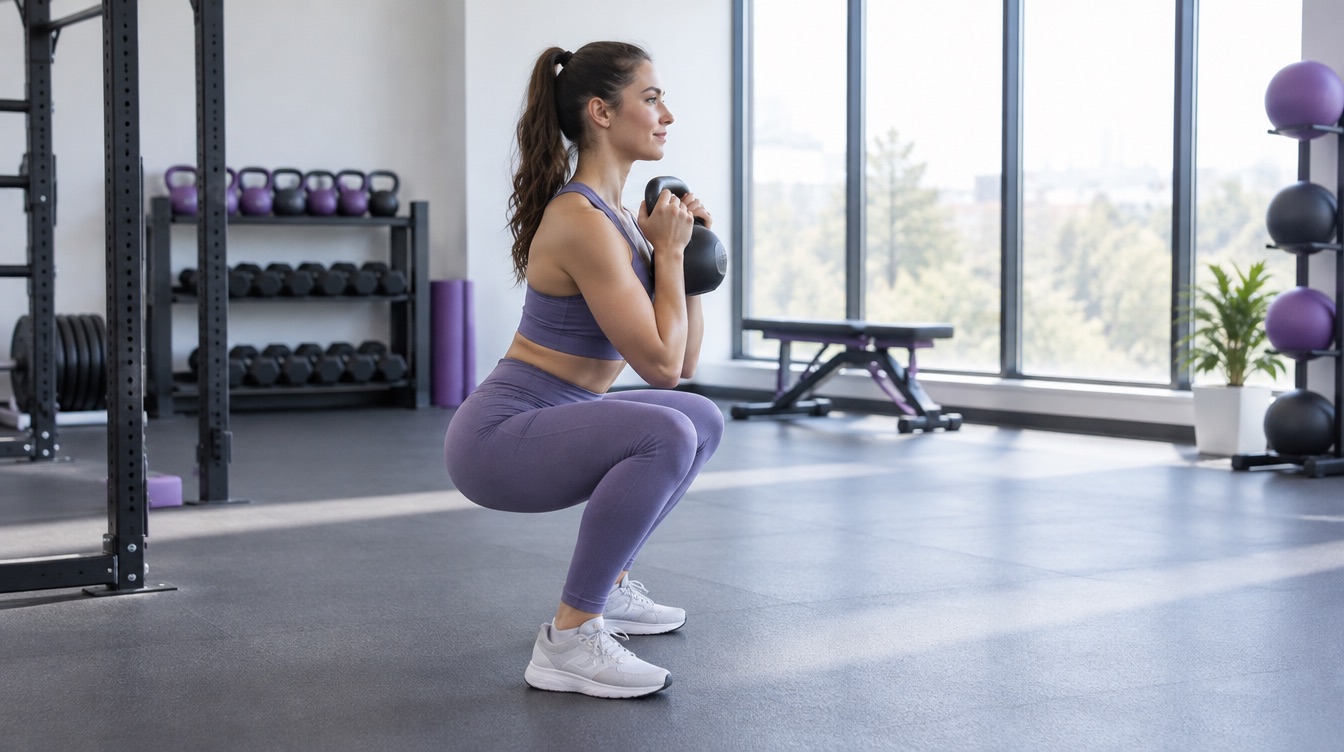
- Goblet squat: hold the dumbbell against your chest, feet about shoulder-width, sit down between your heels, keep your chest up and knees tracking over your toes.
- Romanian deadlift: soft knees, push your hips back, keep the weights close to your legs and your back neutral. Stop when you feel a strong stretch in your hamstrings.
- Bench press: shoulder blades pulled back, feet flat, lower the weights under control to chest level, then press.
- Rows and pulldowns: lead with your elbows and squeeze your shoulder blades together. Avoid swinging.
If you are unsure about your form, film a set from the side or ask a trainer to check it once. Small corrections early save a lot of trouble later.
Nutrition and recovery
- Protein: aim for about 1.6 g per kilogram of body weight per day. Use our protein calculator to find your number.
- Calories: if you want to build muscle, eat around maintenance or slightly above. If you want to lose fat, a small deficit is fine. Beginners can often lose fat and gain muscle at the same time.
- Sleep: 7–9 hours. It matters more than any supplement.
What to expect
In the first four weeks, most of your strength gains will come from your nervous system learning the movements. You will feel more coordinated and the weights will go up quickly. Visible muscle changes usually start to show after two to three months of consistent training and good nutrition. Muscle soreness in the first weeks is normal and fades as your body adapts.
When to change the program
Stay on this plan for at least 8–12 weeks, or as long as you keep making progress. When progress slows down on most lifts despite good sleep and nutrition, you are ready for an intermediate program, such as an upper/lower split four days a week.
The bottom line
You do not need a complicated routine to get started. Three full-body sessions a week, a handful of basic exercises, steady progression and consistent tracking will take you a long way. Show up, write down your numbers, and try to beat them a little next time.
This article is general information. If you have an injury or health condition, check with a doctor or physiotherapist before starting a new training program.