How to Read a Nutrition Label in 60 Seconds
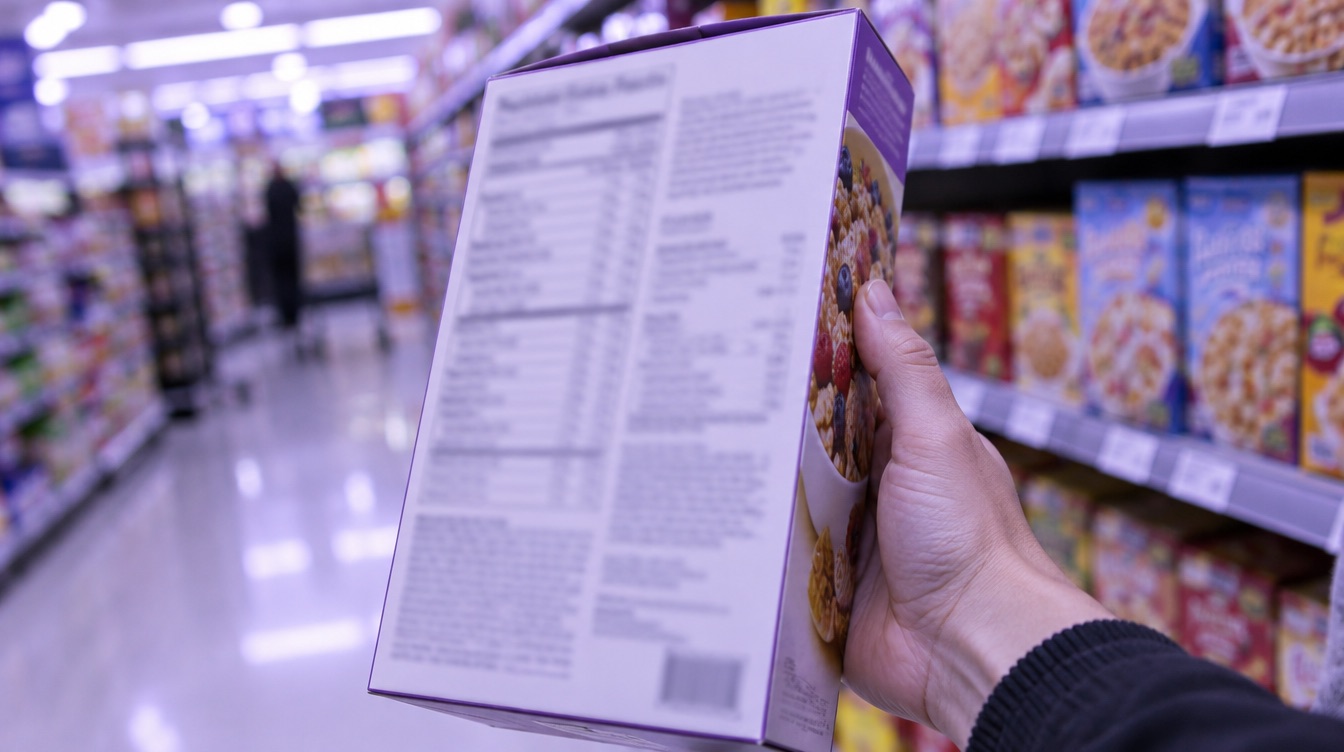
The front of a food package is advertising. Words like "natural", "light", "high protein" or "made with whole grains" are there to sell. The back of the package, the nutrition label and the ingredients list, is where the facts are. Once you know what to look at, you can judge almost any product in under a minute. Here is a quick, practical guide.
Step 1: Check the serving size
Everything on the label depends on the serving size, so start there. Manufacturers sometimes choose small servings to make the numbers look better. A bag of crisps might list "per 30 g serving", while most people eat 50–75 g in one go. A bottle of soda might technically contain two servings.
Ask yourself: how much will I actually eat? Then multiply. If you eat double the listed serving, you eat double the calories, sugar and salt.
In the EU and UK, labels must also show values per 100 g or 100 ml. This is the easiest way to compare two similar products side by side, because it removes the serving size game entirely.
Step 2: Look at calories
Calories tell you how much energy the food contains. Compare them with how filling the food is likely to be. For example, 100 g of granola can contain 450 kcal or more, about the same as a full meal, while 100 g of plain yogurt has around 60–100 kcal. Neither is "bad", but knowing the number helps you choose your portion.
A useful rough guide per 100 g: under about 150 kcal is low energy density (very filling for its calories), and over about 400 kcal is high energy density, so portions matter more.
Step 3: Protein, fat and carbohydrates
- Protein: more protein usually means a more filling product. A "high protein" claim in the EU means at least 20% of the product's calories come from protein. Compare grams of protein per 100 kcal to see which option gives you more.
- Fat: pay attention to saturated fat. A product is generally considered high in saturated fat at more than 5 g per 100 g (UK traffic-light system). Trans fats should ideally be zero, and "partially hydrogenated oils" in the ingredients are a red flag.
- Carbohydrates: look at the "of which sugars" or "added sugars" line, and at fibre.
Step 4: Sugar, the most important line for many products
In the US, labels show "Added sugars" separately, which is very helpful. In the EU and UK, labels show total sugars, which includes natural sugars from milk and fruit. In that case, read the ingredients list to see whether sugar has been added.
The World Health Organization recommends keeping free sugars below 10% of daily calories, and ideally below 5%. For a 2,000 kcal diet, 10% is about 50 g, roughly 12 teaspoons. A single flavoured yogurt or a "healthy" cereal bar can contain a surprising chunk of that.
The UK traffic-light guide considers more than 22.5 g of total sugars per 100 g high and 5 g or less low.
Step 5: Fibre and salt
- Fibre: 3 g per 100 g counts as a "source of fibre" in the EU, and 6 g per 100 g as "high fibre". For bread and cereals, higher is better.
- Salt: more than 1.5 g of salt per 100 g is high, and 0.3 g or less is low. Some labels show sodium instead of salt; multiply sodium by 2.5 to get salt. Ready meals, sauces, bread, cured meats and cheese are the biggest hidden sources for most people.
Step 6: Read the ingredients list
Ingredients are listed in order of weight, from most to least. That tells you a lot:
- If sugar (or one of its other names) is in the first three ingredients, the product is mainly sugar.
- "Wholegrain" bread should have a wholegrain flour as the first ingredient, not plain wheat flour.
- A shorter list of recognisable ingredients usually means a less processed food, although this is a guideline, not a rule.
Sugar hides under many names: glucose, fructose, sucrose, dextrose, maltose, corn syrup, glucose-fructose syrup, invert sugar, honey, agave, maple syrup, fruit juice concentrate, malt extract and others. If several of these appear separately, the total amount of sugar can be high even when none of them is first on the list.
Step 7: Do not trust front-of-pack claims blindly
- "Low fat" products often replace fat with sugar and can have just as many calories.
- "No added sugar" can still mean lots of natural sugar, such as in fruit juice.
- "Natural" has no strict legal meaning in many countries.
- "Made with whole grains" may mean only a small amount of whole grain.
- "Protein" snacks can be high in sugar and calories. Check the numbers.
The 60-second routine
- Serving size versus how much you will eat.
- Calories per serving (and per 100 g to compare).
- Protein: is it a meaningful amount?
- Sugar and saturated fat: high, medium or low?
- Fibre and salt.
- First three ingredients.
The bottom line
Labels are not perfect, as values can legally vary a little from the real content, but they are by far the best information you have in the shop. Ignore the marketing on the front, check the serving size, compare per 100 g, keep an eye on sugar, saturated fat and salt and read the first few ingredients. After a few shopping trips it becomes automatic. Scanning a product's barcode into a food tracker is an even faster way to see the full numbers and keep a record of what you eat.
This article is general information, not medical advice. People with allergies, intolerances or medical diets should always check the full ingredients and allergen information.